Territory
The Park mainly has outcrops of the Piedmont calc-schist complex with greenstone (ophiolite of the ultrabasic rock complex of Mont Avic prevail in Val Chalamy; calc-schist prevail in Champorcher Valley). The ophiolites are a fragment of the Piedmont oceanic basin, involved in the alpine orogenesis following the continental collision between Africa and Europe.
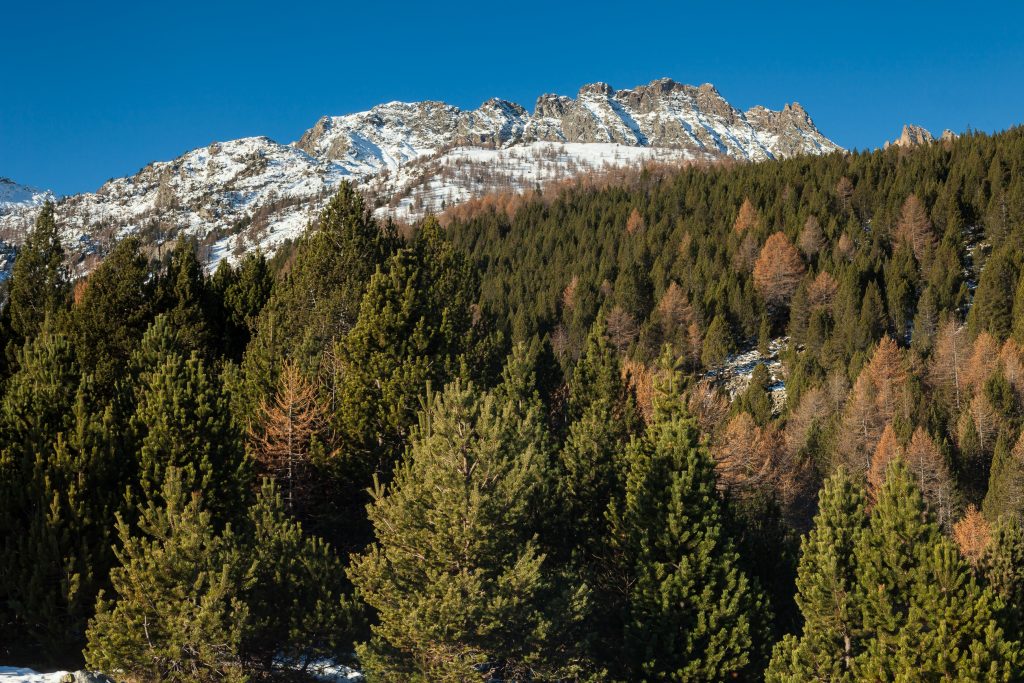
From the morphological point of view, the territory of the Park is still in a youthful evolutionary phase with high reliefs, deep valley incisions and steep slopes.
The morphology is the result of numerous factors, such as the combined erosive and deposit action of watercourses and glaciers, with the formation of glacial cirques and corresponding alpine cirque lakes, moraine deposits of considerable extension and depth, significant differences in height between the valley floor and the reliefs.
The morphology of the Val Chalamy is characterised by high reliefs and deep valley incisions. The direction of schistosity of the metamorphic rocks is relatively homogeneous with immersion prevalent towards the north determining a sharp asymmetry of the two main slopes: on the left bank the slopes are steeper, while the right bank has a gentler morphology alternating hillocks, shelves and depressions (these last partly a consequence of swarms of faults).
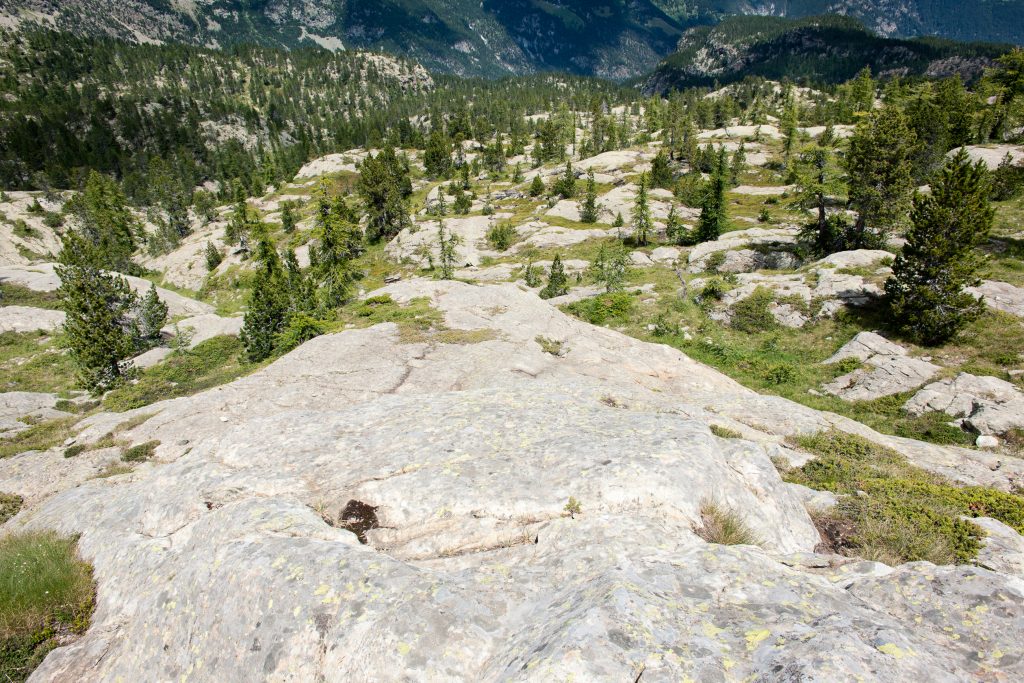
The action of the Quaternary glaciers (erosion, ablation and deposit) is particularly evident in the southern sector of the valley, rich in smooth, striated rocks and roche moutonnée, as well as numerous glacial cirques currently filled by bodies of water. In the eastern portion can be seen significant moraine deposits and numerous erratic boulders.
The water courses have dug deeply into the valley, contributing to the transport of solid materials towards its outlet: the imposing fluvio-glacial deposits immediately downstream of Chevrère are made evident by the processes of instability that have led to conspicuous erosion furrows, rather unusual in the alpine environment.
The Champdepraz area is part of the Piedmontese Calc-schist complex with greenstone. The calc-schist are made up of rocks low or even free of calcite, and include sericite phyllite, mica schists and, more rarely, quartzite and albite gneiss. Greenstones are metamorphic derivatives of basic intrusive rocks; these are mainly gneissic prasinites, or prasinitic gneisses gradually passing to prasinites by a decrease in quartz and muscovite.
Unlike some neighbouring sectors of Champorcher Valley where there are mostly calc-schists with poor intercalations of prasinites and some lenses of serpentinite, within the Champdepraz territory powerful successions of greenstone emerge, with a prevalence of peridotites (tectonic peridotites of Mont Avic), eclogite metagabbro, eclogite-glaucophanite metabasalt, alternating with volcanic sedimentary sequences. In this area, within the Park and in its immediate surroundings, there are some particularly interesting mineralizations, since at least some of them were worked for a very long period and up to the first half of the last century. The magnetite mineralizations of Lake Gelato located at 2,600m were already being mined in 1693 and their exploitation continued intermittently until 1893. The iron-copper mineralizations of Hérin, located outside the Park above the chief town of Champdepraz at 1700m, were intensively exploited in the 18th century and intermittently until 1951.
Also noteworthy are the numerous minerals found in several parts of the Park within rodingite veins (apatite, epidote, garnet, smaragdite, vesuvianite, etc.).
The quaternary surface deposits of the Champdepraz area constitute frequent and relatively continuous outcrops. These are mainly glacial deposits, bottom and lateral moraines from the last phases of the post-Wurm retreat or from recent glacial phases (little ice age), debris deposits, cones or aquifers, originating from the decay and subsequent gravitational deposition at the foot of the rock walls, and peat sediments resulting from the filling of the numerous lake beds and paleo-lake beds. The moraine deposits appear extended throughout the valley floor, mainly from 1,300 to 800m, testifying to the presence, during the glacial periods, of large glaciers. Moraines are chaotic clusters of rocks of different lithology and particle size, consisting of a sandy or silty matrix which includes even large rock fragments. Alluvial deposits are small size deposits on the valley floor, mainly comprising gravel and sand, but also blocks of considerable size, which can be seen in the river bed of Torrente Chalamy.
The overall features of the recently enlarged area of the Park, which is the top portion of the Torrente Ayasse water catchment area, differ distinctly from those found in the Champdepraz valley: specifically, the extensive outcrops of calc-schist and the presence of deeper and more fertile soil ensures a higher percentage of vegetation cover than in Val Chalamy, with a considerable variety of flowers in the alpine plain. On the north side of the Rosa dei Bianchi mountain, a glacier can be seen that is clearly larger than the residual glacial system located on the northern slopes of Mont Glacier.
In the absence of substantial glacial systems, the sources in the summer for the main waterways are the late melting of the snow on the high slopes exposed to the north and the water contained in the debris-moraine coulters. The hydrological regime, characterised by significant changes in flow rate also due to the predominantly superficial soils, is very low in the winter and very high in late spring. The circulation of groundwater is abundant and widespread, with the consequent presence of numerous springs; the resurgences located on the lower left bank of Val Chalamy determine specific environmental contrasts, since they are inserted in what tend to be xeric environments.
AMBIENTI NATURA 2000
Mont Avic Natural Park has been included in the European Union ecological network “Natura 2000” which aims to guarantee the conservation of the habitats and species listed in the European Union’s Birds Directive 2009/147/EC and Habitats Directive 92/43/EEC. The protected area is classified as a Special Area of Conservation (SAC IT1202000) and Special Protection Area (SPA Mont Avic – Mont Emilius IT202020).
Mont Avic Natural Park protects numerous habitats and species considered of high interest by the European Union. In 2011, the Autonomous Region of Valle d’Aosta approved the conservation measures to be applied in the SACs and SPAs, including those concerning the Mont Avic area. Three of the most important environments – the deciduous and coniferous forests, the peat bogs and the high altitude ophiolite sites – were the subject of a protection project carried out by the Park Authority in the four-year period 1997-2000 as part of the “Life-Natura” programme, co-financed by the EU which met half the expenses incurred. The project’s actions were the following:
- scientific research on environments of particular naturalistic value;
- restoration of the trail network, aimed at efficiently channelling the flow of visitors;
- rationalisation of grazing in vulnerable environments (especially peat bogs);
- production of information tools (illustrated panels and brochures). The European Community granted a financial contribution amounting to 50% of the expenses incurred.
The deciduous and coniferous forests.
Forests dominate the landscape of the Park, covering the slopes almost uninterruptedly up to an altitude of over 2000m. The presence of the largest Mountain Pine forest in the Italian Alps and Beech woods, absent in the entire upper-middle Valle d’Aosta, makes Val Chalamy completely original in the region.
The forest fauna varies widely; among the innumerable insects, over 110 species of beetles have been found that feed on the trees and some butterflies that are not widespread in the region (Limenitis populi, Apatura iris, Drepana cultraria, Nemapogon wolfiella). The birdlife also includes Black Grouse, Black Woodpecker; Northern Nutcracker, Citril Finch and predators such as the Northern Goshawk and the Boreal Owl. Among the mammals there are Roe Deer, Alpine Chamois, Red Squirrel and the Garden Dormouse.
The Serva Mountain Pine forest is officially classified among the “seed woods” of national interest.
The protection of Mont Avic’s forests is assured by concentrating people’s presence to the trail network and limiting cutting: only cultivation operations to improve the “seed forest” and moderate use of wood in the most productive and least vulnerable sectors are currently authorised.
The peat bogs
Peat bogs, environments which are usually poorly represented in the valleys of the western Italian Alps, are however numerous in Mont Avic Park and can be indicated as the most important biotopes in the protected area, hosting a large number of animal and vegetable species that elsewhere in Valley d’Aosta are rare or absent. This is due to the presence of a mosaic of different micro-environmental situations: it is possible to see all the stages of the process of burying lake basins that gives rise to the peat bogs at a height of between 1270m and 2550m and in very variable mountain situations.
The peat bog flora includes numerous mosses (including 13 different sphagnum), rare species such as Carex limosa, Carex pauciflora, Trichophorum alpinum and the curious Drosera rotundifolia, a small insectivorous plant very localised in Valle d’Aosta. In summer, many wetlands are covered with the characteristic white plumes of cotton grass (Eriophorum scheuzeri, E. angustifolium and, more localised, E. vaginatum).
Among the animals, a remarkable variety of insects stands out, some of which are rare or not widespread in the Italian Alps (in particular, dragonflies, damselflies, and Hydroadephaga coleopters). The most frequent vertebrates are the Common Frog and the Pigmy Shrew.
Peat bogs are extremely vulnerable environments. Their protection requires maintaining the natural surface water flow unchanged and avoiding any slight disturbance of the plant cover resulting from the passage of people or domestic livestock; the Park Authority therefore periodically places sections of fence to protect some of the most precious wetlands.
The high altitude ophiolite sites
These are characterised by the predominance of greenstones (mainly serpentinite and metamorphosed gabbros alternating with peridotite), which give rise to nutrient-poor superficial soils, full of heavy metals that are toxic effects to most plants. The vegetation cover is consequently reduced and offers limited feeding possibilities to the animals, which are nonetheless present in a surprising variety of species.
The serpentinite flora is very particular: mostly herbaceous plants that tolerate the presence of toxic microelements, such as crucifers of the genera Thlaspi and Cardamine. The numerous species of lichens that cover the rocks are indicative that the sites are highly natural and that there is an almost total absence of polluting agents. The notable frequency of parasitic lichens that grow at the expense of other lichens is probably linked to environmental conditions due to the climate and the particular characteristics of greenstone.
The reduced vegetation cover of the high altitude ophiolite sites provides little in the way of food resources to the alpine fauna, negatively influencing their populations. Among the mammals inside the Park there are 280 to 300 Alpine Chamois, a few dozen Alpine Ibex, Mountain Hares, Ermines and some Alpine Marmot colonies. A dozen species of birds manage to nest in these inhospitable environments and only the Rock Ptarmigan is able to winter at high altitude even in the presence of an abundant and continuous snow cover. Insects, on the other hand, come in a large number of species: as an example, coleopters belonging to as many as 22 different families have been found.
For effective protection of ophiolite sites, it is advisable not to stray from the marked trails, in order to limit the disturbance to the fauna and avoid damage to the plant cover.